
Polished or Matte Tile: Choosing a Finish for a Kitchen and Bathroom You Actually Use
Most people choose a tile finish by accident.
They pick a tile they like from a display board, the board happens to be polished or happens to be matte, and that is the finish that ends up on the floor. The color got a decision. The finish got whatever came with it.
That is a shame, because on the two surfaces this most affects — a bathroom floor and a kitchen floor — finish does more day-to-day work than color does. It decides how the room handles light, how often it looks dirty, and how it behaves under a wet foot.
Porcelain is usually sold in both. Same tile, same color, two finishes. Choosing between them is genuinely worth ten minutes.
What the two finishes actually are
Polished porcelain has been mechanically ground and buffed to a reflective, glass-like surface. It bounces light. Colors look deeper and veining looks wetter, in the way a stone looks better when you run it under a tap.
Matte porcelain is left with a low-sheen surface and some degree of microtexture. It absorbs light rather than throwing it, so color reads flatter and truer, closer to how the tile looks in a box.
That is the entire physical difference, and every practical consequence below comes out of it.

The number that matters on a floor
Slip resistance in tile is measured as DCOF — dynamic coefficient of friction — tested wet. It is a published figure, and for interior floor tile the benchmark the industry works to is 0.42 or above when wet.
Matte and textured porcelain is where you find tiles that meet or exceed that threshold. Polished porcelain, by the nature of what polishing does, generally sits below it. MSI publishes DCOF figures for its tile, and if a tile is going on a floor that gets wet, that number is worth asking for by name rather than assuming.
Two honest caveats, because this gets oversold in both directions.
DCOF is a wet-floor measurement, and a dry polished floor is not a hazard. Plenty of polished tile lives happily in dry interior rooms. And a high DCOF is not a promise — no floor tile is non-slip, and a matte floor with standing water on it is still a wet floor.
What the number is good for is comparison. Between two tiles you like for the same wet floor, it tells you something real.
Polished earns its place on walls more often than floors
The case for polished is light, and it is a strong case.
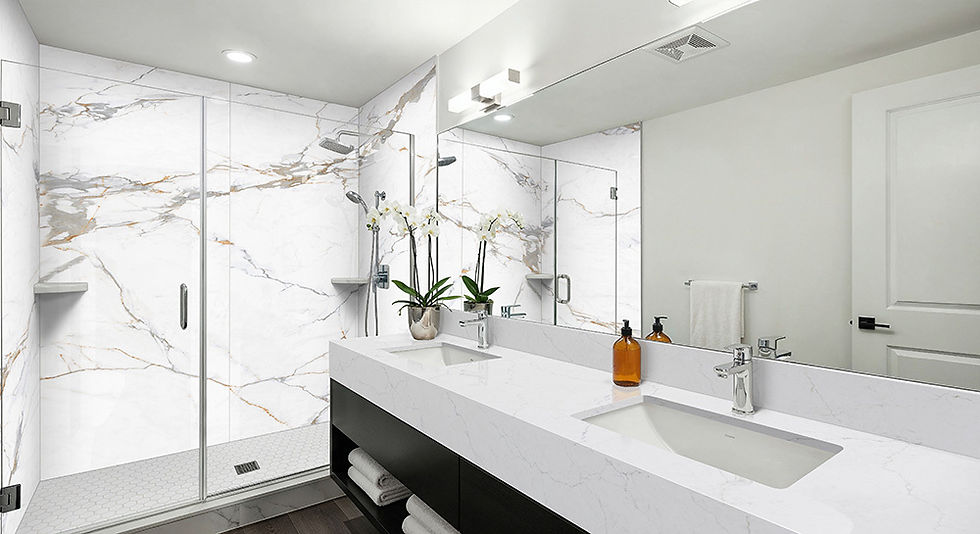
A polished tile on a wall does something matte cannot: it takes light from a window or a fixture and pushes it back into the room. In a small, dark or interior bathroom — the ones with no window, which North Bergen and the surrounding towns have plenty of in older housing stock — a polished wall tile can be the difference between a room that feels cramped and one that doesn't.
Vertical surfaces also sidestep the whole problem. Nobody walks on a shower wall. Nobody drops a pan on a backsplash. The reasons to be careful with polished tile are almost all floor reasons.
So the pattern that works in a lot of houses is polished where it can catch light and stay out of the way, matte where feet and water are.
Matte hides more than people expect
The underrated argument for matte is not slip resistance. It is that matte floors look clean for longer.
A polished floor shows footprints, dust, water spots and the smeary halo left by a mop that was slightly too wet. It shows them because it is reflective, and any interruption to a reflective surface is visible. It is the same reason a black car looks dirty two days after washing and a silver one doesn't.
Matte scatters light instead of reflecting it, so the same dust and the same footprints simply do not register. The floor is no cleaner. It just does not announce itself.
In a kitchen, where the floor collects the fine grease film that comes off any range over time, this is not a small consideration. Over a year, a matte kitchen floor asks less of you for the same result.
The bathroom is where this actually gets decided
If you take one thing from this: bathroom floors are the surface where finish is not really a preference.
A bathroom floor is wet regularly, walked on barefoot, and often used by someone standing on one leg getting out of a shower. That combination is the specific case DCOF exists for. Matte or textured is the sensible default, and it is more so in a household with young children or older adults.
The tolerance narrows further inside a shower. Shower floors are usually specified in a smaller tile — mosaic or small format — for a reason that has nothing to do with looks: more grout lines mean more grip, and a small tile follows the fall to the drain better. Finish and format work together there.
None of which stops you using a polished tile on the shower walls above it, and plenty of good bathrooms do exactly that. If you are working through a bathroom more broadly, our post on modern bathroom design ideas covers the decisions that sit around this one.
The kitchen floor is a different problem
Kitchen floors are wet less often than bathroom floors but messier in more ways — water at the sink, oil near the range, and things dropped from counter height onto a hard surface.
Matte handles all three better. It grips at the sink, it disguises the grease film, and it hides the fine scuffing a floor picks up from chair legs and dropped utensils.
There is also a point worth making about material choice rather than finish. If a fully hard floor is not what you want underfoot in a kitchen you cook in every day, that is a legitimate reason to look at other flooring entirely — we covered the case for luxury vinyl tile in a kitchen recently, including how it sits against cabinetry and countertops. Tile is not the only answer, and it is better to know that before you have specified it.
Light changes what you are looking at
A tile sample under bright, even, overhead showroom light is being shown in the most flattering and least representative conditions it will ever see.
Polished tile in particular is transformed by directional light. Under a window or a row of downlights, a polished floor develops bright hotspots and glare that simply are not present on a display board. Sometimes that is beautiful. Sometimes it makes a floor unreadable at nine in the morning.
Matte is far more predictable and looks much the same in most light, which is part of why it is the safer default when you cannot test properly.
This is the same trap that catches people with under-cabinet lighting and backsplashes — light raking across a surface at a shallow angle exaggerates every texture and every imperfection in it. We wrote about that in what to decide about kitchen lighting before your cabinets are ordered, and the interaction runs both ways: the lighting affects the tile, and the tile affects what the lighting does.
Mixing finishes in one room is normal
There is a persistent instinct that a room should be all one finish. It shouldn't, necessarily.
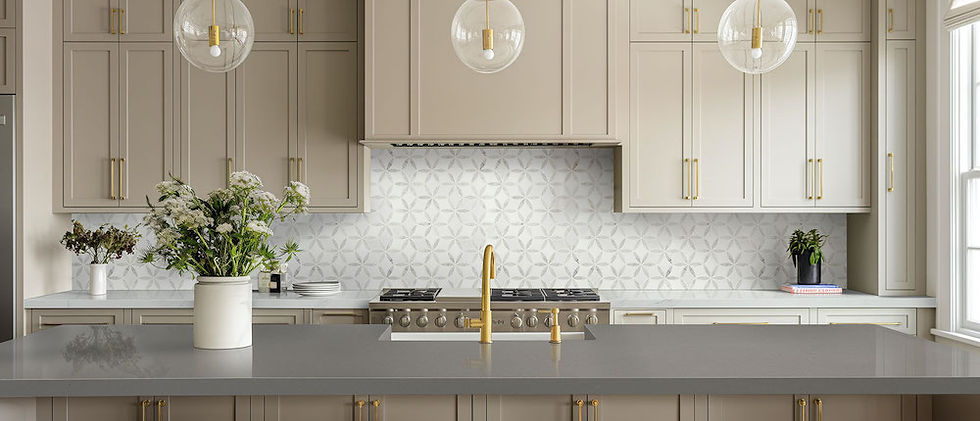
The most common good combination is a matte floor with polished or gloss tile on the walls — grip where you stand, light where you don't. In a kitchen, a matte floor under a gloss backsplash does the same job.
You can also use the same tile in both finishes, which reads as deliberate rather than indecisive and keeps color perfectly consistent between floor and wall. Many porcelain ranges, MSI's included, are produced in matched finishes precisely so this is possible.
Mixing materials within one surface is a related idea and one we have written about before — see our post on mixing materials in a backsplash for where that works and where it turns busy.
What each finish asks of you
Both are porcelain, so both are non-porous and neither needs sealing. The tile does not, at least — grout is a separate question, and often does.
Day to day, matte wants regular sweeping and a neutral pH cleaner, and its microtexture will hold onto grime if it is neglected for a long stretch. The texture that grips a foot also grips dirt.
Polished wants more frequent attention to look its best, and it is less forgiving of the wrong cleaner. Anything abrasive will dull the polish permanently, and film-leaving cleaners show badly on a reflective surface.
Neither is difficult. They just fail differently: a neglected matte floor gets gradually grubby in the texture, a neglected polished floor looks streaky almost immediately.
A short way to decide
Go surface by surface rather than room by room, and ask two questions.
Will it be walked on wet or barefoot? If yes, matte or textured, and check the DCOF.
Does the surface need to give light back? If yes, and it is vertical, polished is doing real work.
Almost everything else is aesthetic, and you should choose what you like.
Seeing samples properly
The reason to look at tile in person is not the color. It is the finish, and it is specifically to see a sample tilted toward a light source instead of lying flat under one.
Our showroom on Tonnelle Avenue in North Bergen carries the tile ranges we work with, and a sample can be taken to the window and turned, which is genuinely the whole test. If the tile is going into a kitchen where the cabinetry is not settled yet, it is worth looking at both together — our kitchen cabinetry range is in the same room, and floor tile against a cabinet door in the same light is a more useful comparison than either on its own.
If you would rather talk it through with someone before deciding anything, book a consultation. Bring photos of the room and, if you can, note where the light comes in. It matters more than most people expect.
Comments