
Kitchen Cabinet Door Styles: Shaker, Slab, and Raised Panel, Honestly Compared
Cabinet doors are most of what you see when you walk into a kitchen. The boxes behind them are hidden, the hinges are hidden, and the interior fittings only show when something is open. The doors are on display every hour of every day.
They are also the part of a kitchen that is hardest to change your mind about. You can swap hardware in an afternoon. Replacing every door and drawer front because the profile stopped feeling right is a different kind of project, and it is rarely worth doing on its own.
Door style is also one of the few kitchen decisions you can genuinely test before you commit. Here is how the three main styles differ, and what each asks of you after the installers leave.
First, what a door style does not decide
Door style and cabinet construction are two separate decisions. The door style is the profile on the front — shaker, slab, raised panel. The construction is how the box itself is built, whether it has a face frame, and how much of that frame the door covers. You can put a shaker door on a framed cabinet or a frameless one, and a slab door either way.
They get discussed together because showroom displays present them together, but they are priced differently and they affect different things. Mixing them up is how people end up with a door they love on a box that does not suit how they cook. Sort the door first, since it is the one you react to emotionally. Then work through framed versus frameless construction separately.
Shaker: the default, and it earned that
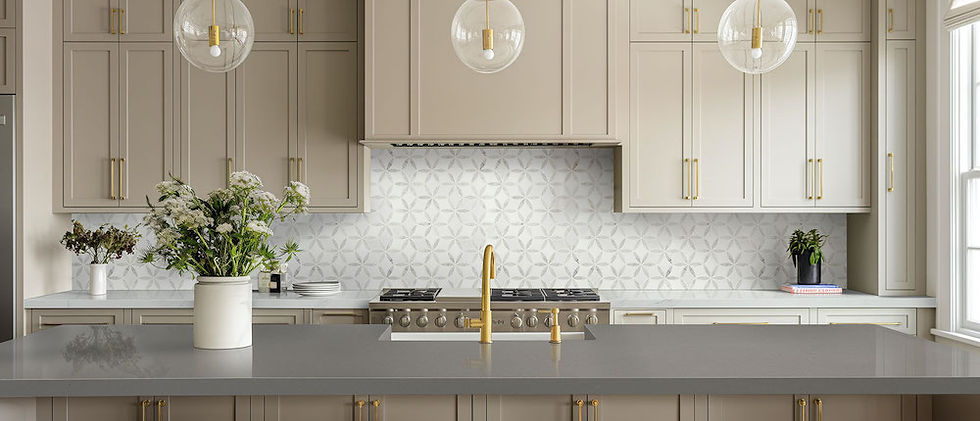
A shaker door is a five-piece door. Four frame pieces — the rails across the top and bottom, the stiles up the sides — surround a flat center panel that sits recessed below them. No carving, no bevel, no profile. The style traces back to the Shaker communities of the late 18th century, whose furniture prized function and plain craft over ornament.

It is the most-requested door style in most showrooms, including ours, for a boring and practical reason: it does not commit you to anything. In a warm stain it reads traditional. In a crisp white with a slim bar pull it reads current. In a deep navy or green it reads like a decision rather than a default. It survives changes in taste because it never leaned hard into one.
Where shaker gets more interesting is rail width. A wide-rail shaker feels solid and a little more traditional. A narrow rail — often sold as slim shaker — keeps the recessed panel but thins the surrounding frame, which reads noticeably more modern while staying unmistakably shaker. Side by side the difference is obvious; in a photograph it often is not, which is exactly why this one is worth seeing in person.

The honest drawback: that recessed panel has an inside corner, and inside corners collect. Where something is frying most nights, the ledge where the panel meets the bottom rail needs wiping more often than a flat door would.
Slab: the quietest door in the room
A slab door — also called flat panel — is a single uninterrupted surface. No frame, no recess, no profile. It is the door style that gets out of the way.

That makes it the natural choice when something else in the room is meant to be the event: a countertop with real movement in the veining, a full-height backsplash, an island in a contrasting color. A busy door profile will fight a statement stone. A slab door will not. It is also the easiest door in the kitchen to keep clean — one wipe and the whole face is done, with nowhere for grease to settle.
The tradeoffs are real. A slab door shows everything: fingerprints on a dark matte finish, any waviness in the surface, any misalignment between neighboring doors. It is unforgiving of sloppy installation in a way a shaker’s shadow lines are not, and it leans harder on hardware to look finished — or on being designed with none at all and an integrated finger pull instead.
If you are drawn to slab, look at it under the lighting you will actually have. A flat surface reads completely differently under warm downlights than under cooler under-cabinet strips, and that lighting decision needs to happen before your cabinets are ordered, not after.
Raised panel: detail that needs the right house
A raised panel door inverts the shaker idea. Instead of the center panel sitting below the frame, it is raised above the surrounding surface, usually with a shaped or beveled edge where the two meet. It has been a fixture of traditional and formal American kitchens since roughly the 1920s.

Raised panel is the most decorative of the three, and that is both the appeal and the constraint. In a center-hall colonial, a Victorian, a house with substantial trim and real moldings, a raised panel door belongs and a slab door can look like it was dropped in from a different building. In a 1960s ranch or a newer open-plan condo, the same door can read heavy. It also has the most surface area to clean, and the deepest profile to clean into.
The test is not whether you like raised panel doors in a photograph. It is whether the rest of your house is having the same conversation.
What the door does to your hardware budget
This gets overlooked until quoting. Slab doors often use fewer, larger pulls, or none at all with an integrated finger pull. Shaker and raised panel doors nearly always take a knob or pull per door and per drawer, and across thirty-plus openings the difference between an inexpensive knob and a designer pull stops being a rounding error.
Door style also affects how a pull sits. A wide-rail shaker gives you a generous flat stile to mount to. On a slim shaker or a slab, placement is more exposed and a slightly off-center pull is more visible.
How to test a door style before you commit
Take a sample door home. This is the most useful hour in the whole process. Showrooms are lit differently from kitchens: a stain that looked warm under showroom lighting can go orange in a north-facing room, and a crisp white can go cold. We stock sample doors you can order directly, including the Essex maple shaker in Truffle and the Upton knotty rustic birch.
Judge it against your floor and your counter, never on its own — that is the only way it will ever be seen once installed. And open and close a full-size display a few times. How a door feels at the moment it closes tells you as much about the line as the profile does.
Once the door is settled, the next question is the box behind it: framed, frameless, or inset, and how to judge build quality.
See all three side by side in North Bergen
Photographs flatten the one thing that distinguishes these doors: depth. A shaker’s shadow line, a raised panel’s bevel, a slab’s flatness are three-dimensional qualities, and screens are not.
Our North Bergen showroom displays full kitchens from Fabuwood, Showplace, and JSI, with complete door and color sample sets for each line, so you can hold a shaker and a slab in the same hand and stop guessing. Sterl Kitchens has been family owned and operated in North Bergen since 1945.
Book a free showroom consultation or call (201) 866-7999, and bring a photo of your floor. We will start there.
Comments